Spending Tokens Wisely
How the meter actually runs:
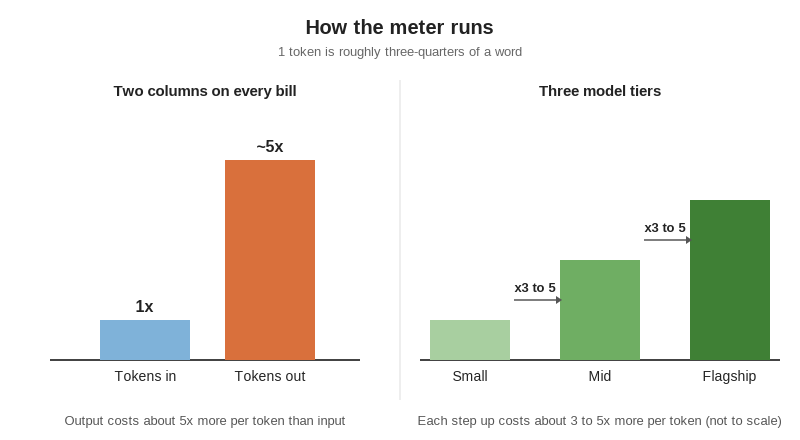
Every model call is billed by the token, roughly three-quarters of a word each, and the bill has two columns: tokens in and tokens out. Output costs several times more per token than input, about 5x as a rule of thumb, partly because the model produces it one token at a time. Model tiers stack on top of that: each step up the ladder, from small to mid to flagship, costs somewhere around 3 to 5 times more per token than the one below.
These ratios, and the dollar figures below, are rough and as of October 2026. They vary by vendor and will change, so check your provider’s current price list. The shape matters more than the numbers.
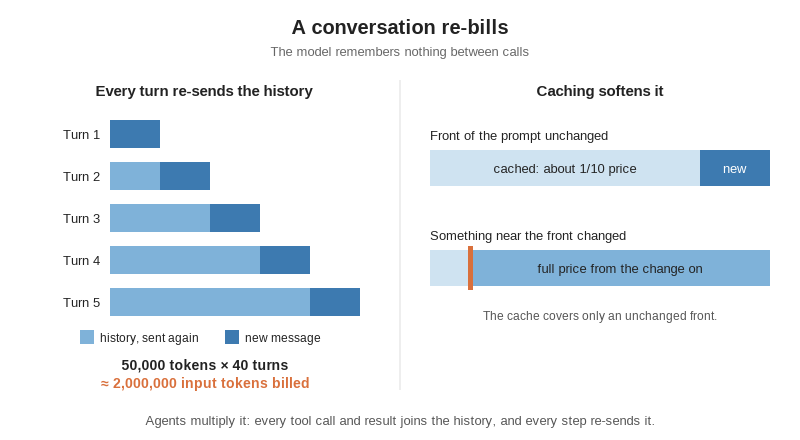
Two things surprise newcomers. The first is that a conversation doesn’t bill once; it re-bills. The model remembers nothing between calls, so every turn sends the entire history again as input. A chat that grows to 50,000 tokens and runs 40 more turns has paid for roughly two million input tokens, not fifty thousand. Caching softens this: repeated material is re-read at about a tenth of the normal input price, but only if the front of the prompt stays unchanged. The second surprise is that agents multiply everything. Each tool call and each tool result is more context, and every step re-sends it.
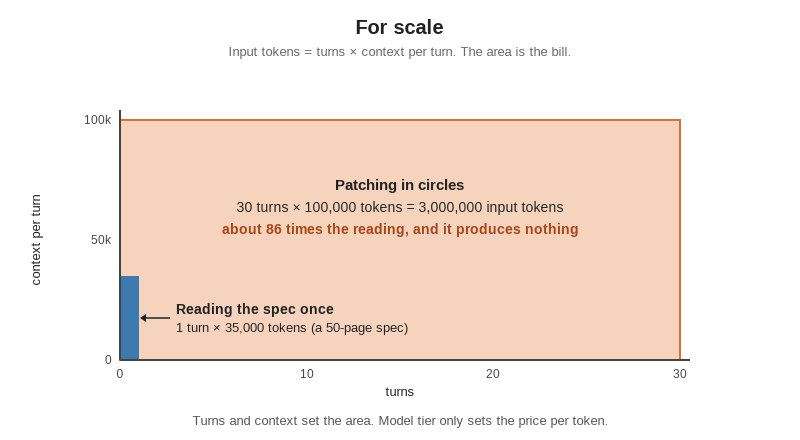
For scale, a 50-page spec is about 35,000 tokens. Having a flagship model read it once costs on the order of a dollar. Having a mid-tier model patch the same bug in circles for 30 turns on a 100,000-token context costs 3 million input tokens, which is several dollars uncached, and it produces no progress. Two factors move the total: how many turns you take, and how much context rides along on each one.
Subscriptions are a different animal. A flat monthly plan hides the meter and substitutes usage limits, so the discipline is the same but the penalty is hitting the cap instead of a bill.
Think in smaller chunks
The cost of a thread is a running total: a + (a+b) + (a+b+c). Every turn pays again for everything before it, so a long thread gets expensive faster than it gets useful. The cure is to cut the work into chunks small enough that the total stays small, and to make the cut deliberately instead of waiting for the thread to choke.
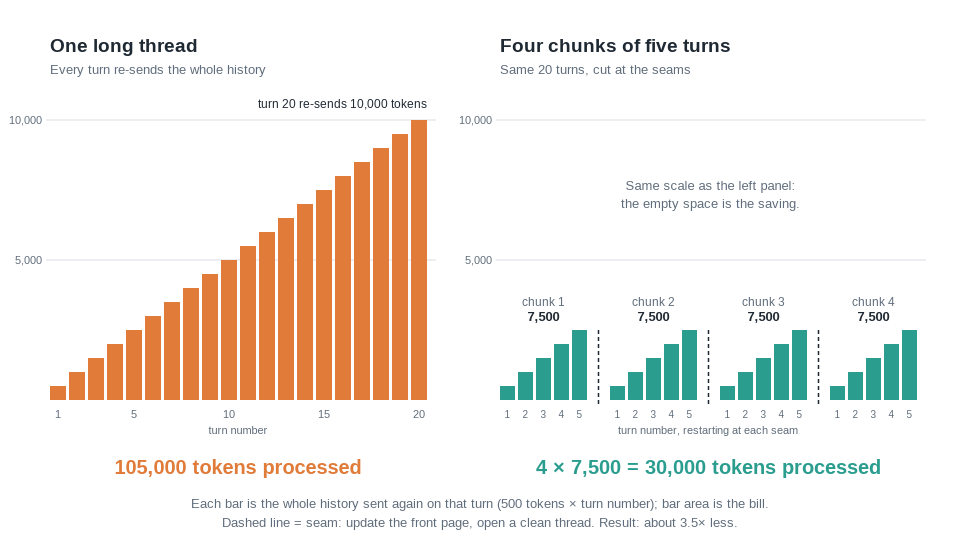
Take this example case, 20 turns of 500 tokens. In one thread that is about 105,000 tokens processed. Cut into four chunks of five turns, each chunk costs about 7,500, so the whole job costs about 30,000. That is a 3.5x saving from nothing but where you put the seams. The fixed material you load (instructions, the front page of the docs) costs the same either way, since it rides along on every turn. What chunking adds is the orientation turn at the start of each new chunk, which is small beside the savings.
Chunking has a second benefit that matters more than the money: smaller chunks of thought. One question per turn, and one decision per chunk. A chunk ends when something is settled and written down, not when the window fills. If a chunk is going in circles, that is Rule 5, and the right move is to stop, record what is known, and open a clean one.
Waste also runs into a limit of its own. A session can hold only so much context, and a thread full of failed attempts reaches that limit early. Many tools then compact the conversation: they replace the history with a summary, and whatever the summary leaves out is gone. A deliberate cut, with the front page updated, keeps what matters. Compaction keeps whatever fits.
This only works if the seam is cheap to cross, which is where the docs come in. The test is the welcome: you open a fresh session, say “welcome, new Claude, have a read of the full system,” and within a minute the model knows where the work floor stands. That means the docs have to answer the questions a newcomer would ask, in an order that lets the model stop reading as soon as it knows enough:
- A front page, short and always current. What the project is, what was decided, what is in progress, what is open, and what the next move is. Keep it to about a page; it is the “a” in the sum, so every line on it is paid for on every turn of every chunk.
- Pointers, not contents. The front page names the deeper documents (decision records, specs, notes) and says when to read each one. The newcomer opens them only when the task touches them.
- A close-out habit. The last act of every chunk is to update the front page. The handoff is the product of the chunk; a chunk that ends without one has cost you the next chunk’s first ten minutes.
- Decisions recorded with their reasons. A fresh session that finds “we chose X” will re-argue it; one that finds “we chose X because Y, and rejected Z for this reason” will build on it.
The two halves fit together: small chunks keep the sum low, and good docs make small chunks cheap to start. Neglect the docs and chunking only turns into re-explaining. Neglect the chunking and the best docs in the world still ride along in a thread that keeps growing.
Two practical limits. First, caching lowers the price of the repeated part, but it doesn’t change the shape: the sum still grows with the square of the turns. Second, the welcome only works if the new session can reach the docs, whether through the repo or project files.
What this means for the five considerations
Rules 4 and 5 are billing arguments. A strong model reading the whole package at the gate costs a dollar or two, against hours of rework. Patching in circles is the expensive failure: every round is billed, and the context only grows.
Rules 1 through 3 are about a different cost: people’s time. A person costs perhaps $50 to $150 an hour, loaded.
So the money spent on tokens is often the small part. The large costs are rework and attention, and tokens are the unit that makes them visible. A decision that isn’t written down is paid for twice: once when it’s made, and again when the model has to ask about it next session.
The cheapest token is the one you never had to regenerate.
